
Creating a great piece of jewelry isn’t just about the materials you choose. It’s also about how they’re placed, paired, and sized. The difference between a piece that feels cohesive and one that looks cluttered often comes down to these basics.
Once you understand the principles of balance, you’ll be able to create jewelry that feels cohesive and easy to wear.
Pick a Central Theme
Before you start adding beads, gems, wires, or accents, decide what your piece will be about.
Your central theme might be a certain color, a stone, a shape, or a technique.
Limit the Number of Focal Points
If you make everything a focal point, there’s nowhere for the eye to land.
Select one thing to focus on and make everything else secondary. This will give your piece a cleaner and more confident look.
Plan for Proportion
Proportion refers to the relationship between the sizes of different parts.
For example, a huge pendant might look out of place on a delicate chain, or small beads might get lost next to a large charm.
Establish a Visual Order
Try mixing different scales. You can center your piece with a large element and then use smaller ones that lead the eye inward.
This method works particularly well for necklaces, bracelets, and statement jewelry.
Use Color Wisely
Color can transform a piece of jewelry.
You can build a soothing design with analogous shades, or add contrast with complementary tones.
Keep a Simple Color Scheme
Choose a base color, a few accent shades, and a metal tone to tie everything together.
You don’t need many colors to make an interesting design. In fact, a narrow range can sometimes result in a more elegant outcome.
Mix Textures Thoughtfully
Jewelry can include shiny metal, matte stones, glossy beads, woven cord, or other textured surfaces.
Combining contrasting textures adds interest, but the various textures should still work together.
Pair Opposites with Restraint
A rough, chunky centerpiece can go nicely with a smooth, polished element. If all of your elements are highly textured, the design can end up looking busy.
Explore Symmetry
Symmetry is an easy way to achieve balance.
Earrings, for instance, are usually symmetrically designed. For necklaces and bracelets, however, you have the option of making them symmetric or asymmetric.
You Can Also Use Asymmetry
A piece doesn’t have to be fully symmetrical to feel balanced.
An asymmetrical design can feel stable when a big piece on one side is offset by a number of smaller pieces on the other.
Consider Practicality
A piece of jewelry needs to look balanced, but it also needs to feel balanced when worn.
A necklace should sit comfortably, a bracelet should flow with the wrist, and earrings shouldn’t be too heavy.
Design for Real Wear
Think about how the finished piece will function when someone is wearing it.
Consider weight, drape, fasteners, and the positioning of larger parts before you commit to a design.
Use Empty Space
Not every part of a piece needs to be full.
Negative space allows individual parts to shine and can help keep the overall design feeling open.
Allow for Breathing Room
The gaps between beads, charms, chains, and embellishments can help establish rhythm and visual clarity.
Sometimes, taking something away will actually strengthen the design.
Try Out Different Combinations
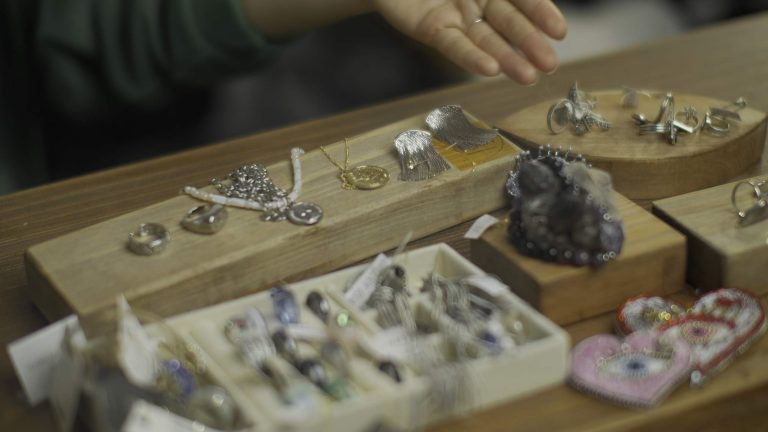
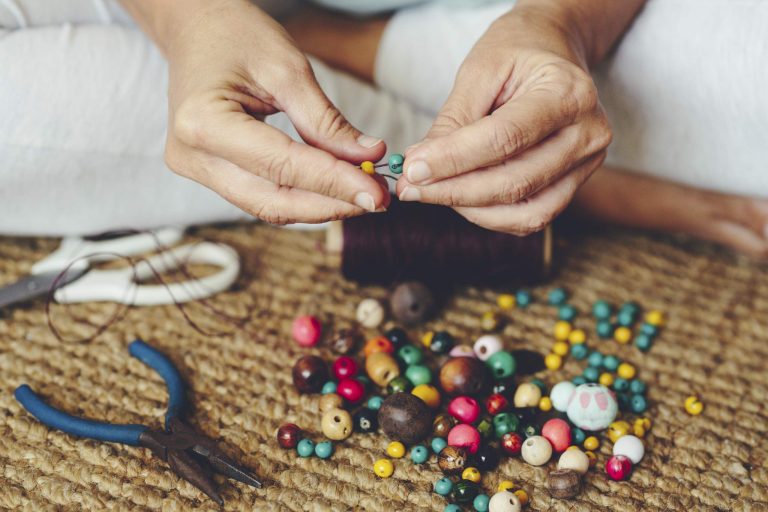
Instead of attaching everything right away, arrange the parts on a table or mat.
Experiment with different layouts.
Snap a Photo
A picture can offer a new perspective. A design that looks balanced in isolation might look cluttered in context.
This simple technique can be surprisingly helpful in the design phase.
Wrapping Up
Good jewelry design requires a careful consideration of proportion, color, texture, symmetry, spacing, and comfort.
Start with one key concept, select a focal point, and allow the rest to complement it. Over time, you’ll learn how to know when a piece needs an extra detail, and when it needs one less.